

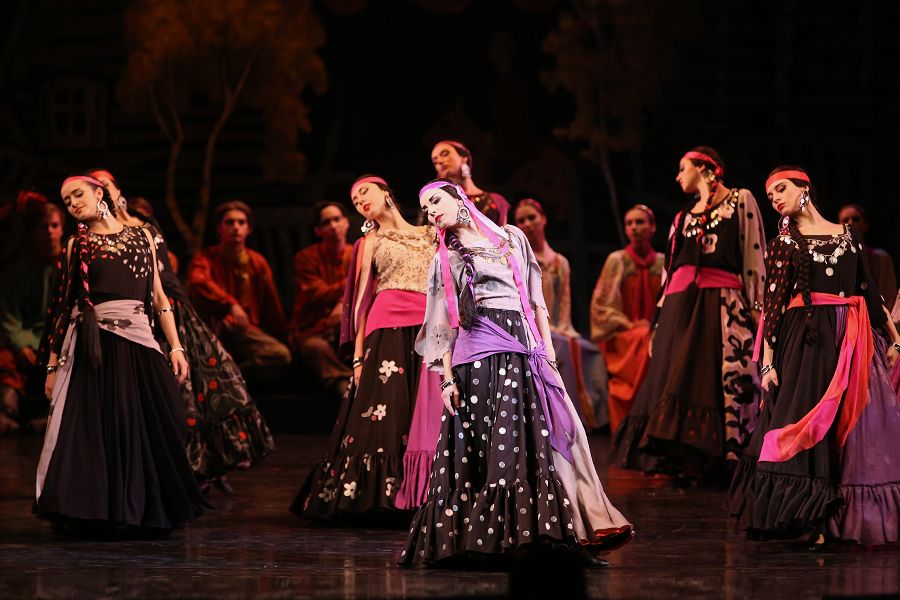
The Stone Flower

ballet by Sergei Prokofiev

Premiere of Sergei Prokofiev's ballet choreographed by Leonid Lavrovsky – 12 February 1954, Bolshoi Theatre, Moscow
Premiere of the ballet choreographed by Yuri Grigorovich – 22 April 1957, the Leningrad Kirov Opera and Ballet Theatre (Mariinsky Theatre)
Revival of production: 6 December 2016
Revival from the 1957 production: 23 April 2026


Running time: 2 hours 50 minutes
The performance has two intervals

Age category: 6+

Credits

Music by Sergei Prokofiev
Libretto by Mira Mendelssohn-Prokofieva and Leonid Lavrovsky, revised by Yuri Grigorovich after motifs of the Ural tales The Malachite Box by Pavel Bazhov
Choreography by Yuri Grigorovich

Musical Director: Valery Gergiev
Revival Set Designer: Mikhail Sapozhnikov
Lighting Designer: Vadim Brodsky
Revival Costume Designer from the 1957 production: Antonia Shestakova

SYNOPSIS

Act I
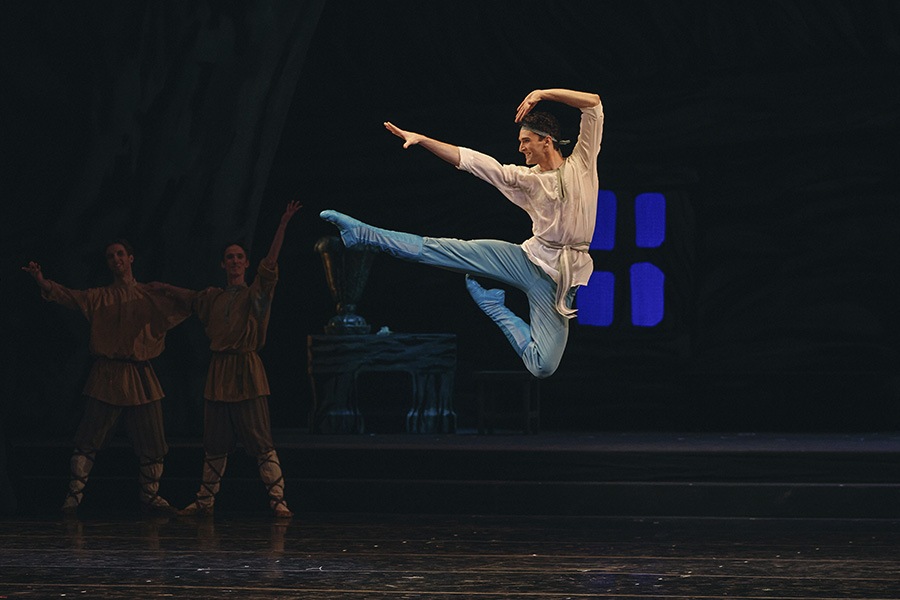
The Ural master stone-cutter Danila dreams of creating a malachite bowl of unprecedented beauty – to embody in stone the grace of a living flower.
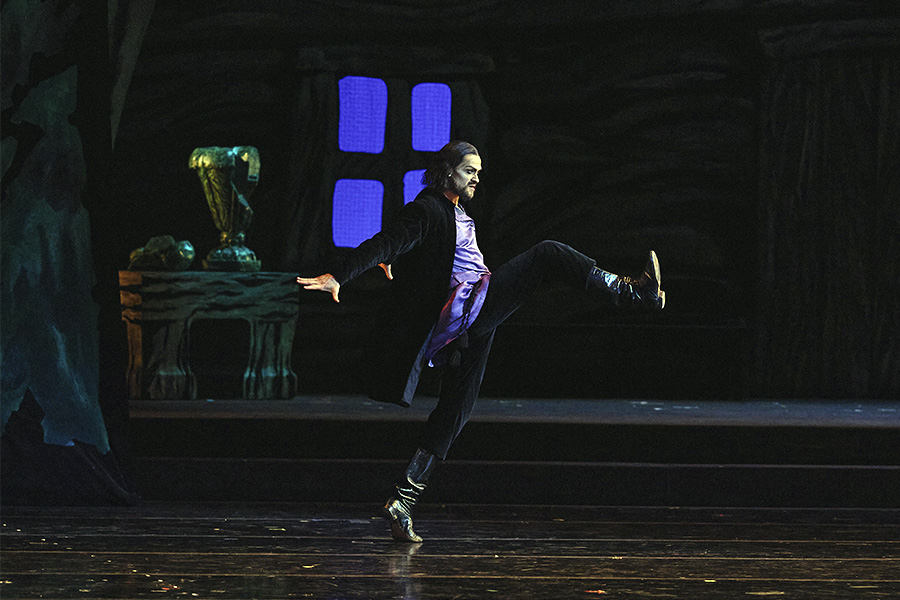
In the village Danila and Katerina’s engagement is being celebrated. An uninvited guest arrives – Severyan, the landowner’s steward, demanding the malachite bowl he commissioned from Danila. Dissatisfied with his own work, the craftsman refuses to hand it over. Enraged by such defiance, the steward raises his whip, but Katerina steps between him and Danila. Forgetting the bowl, Severyan turns his attention to the girl and tries to embrace her.
All depart. Danila remains alone with his thoughts. From the old masters he knows that the Mistress of the Copper Mountain possesses the secret of the stone and guards the underground treasures. Until he learns this secret, he will know no peace.
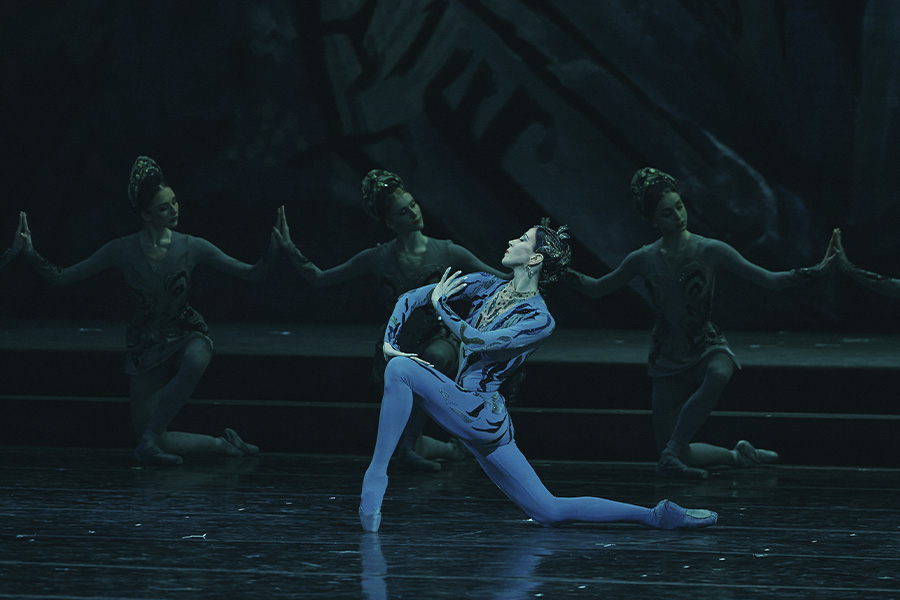
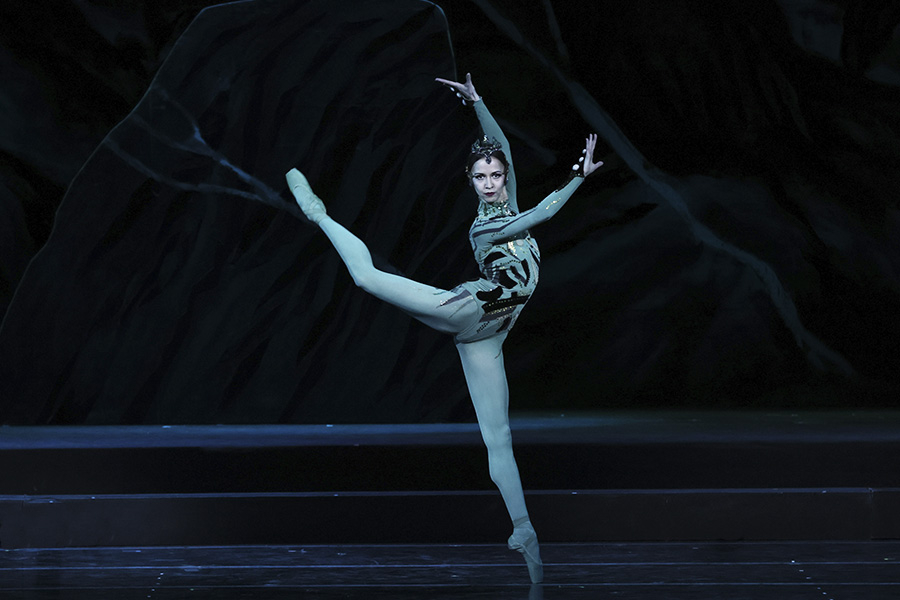
The Mistress appears before him – now as a lizard, now as a “malachite maiden” – and vanishes again. Looking at his bowl, Danila sees how imperfect it is. In despair he shatters it and follows the vision.
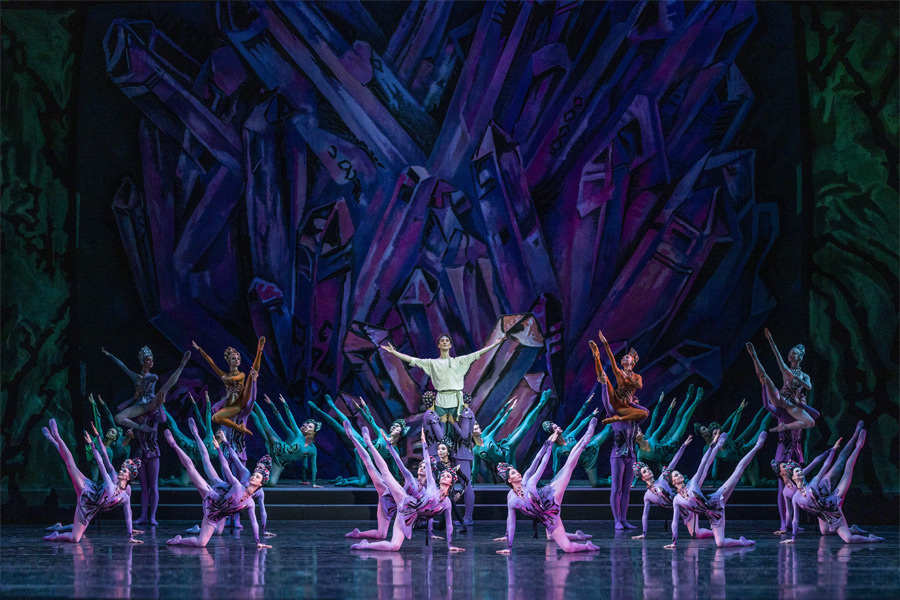
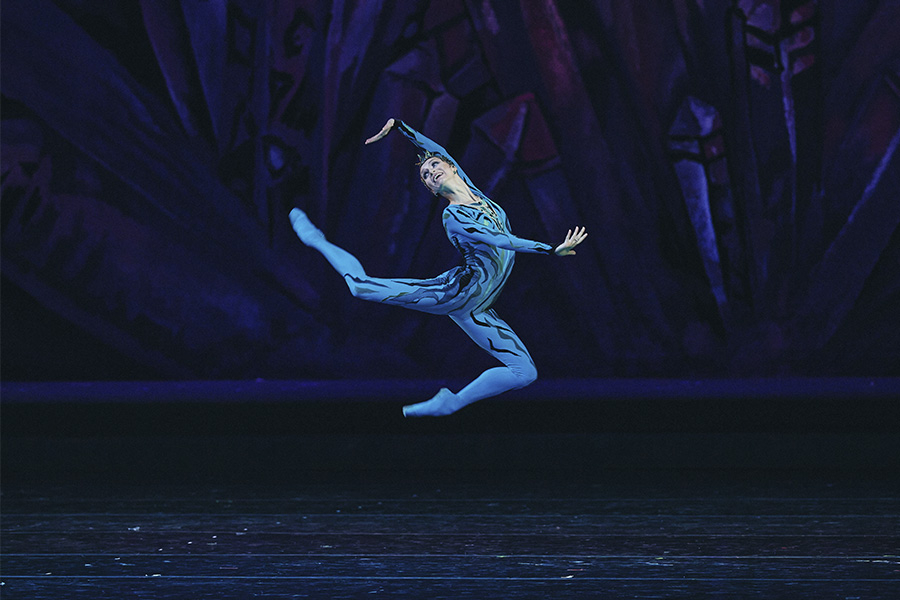
She draws him into her realm, where the stones come alive before his eyes: gemstones shimmer and glisten, and the stone flower – Danila’s dream – blossoms.

Act II
The Mistress reveals ever more of the secrets of her realm to Danila. She has fallen in love with the gifted craftsman and does not wish to lose him. She resolves to keep him in her domain forever.
Meanwhile, Katerina grows sorrowful as she waits for her betrothed, who has been absent for several days. Severyan mocks her – “neither bride nor wife” – and tries to win her by force. Katerina drives him away and resolves to search for Danila.
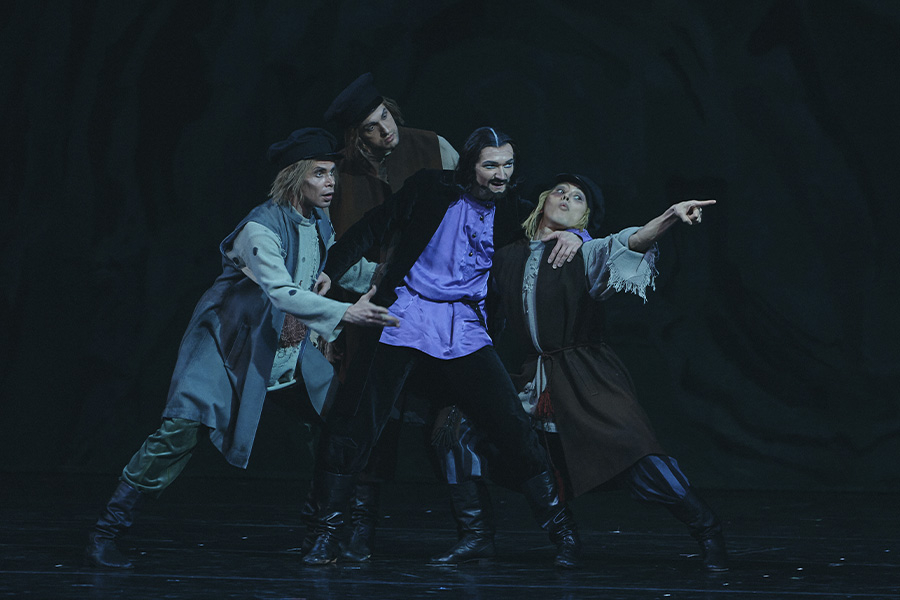
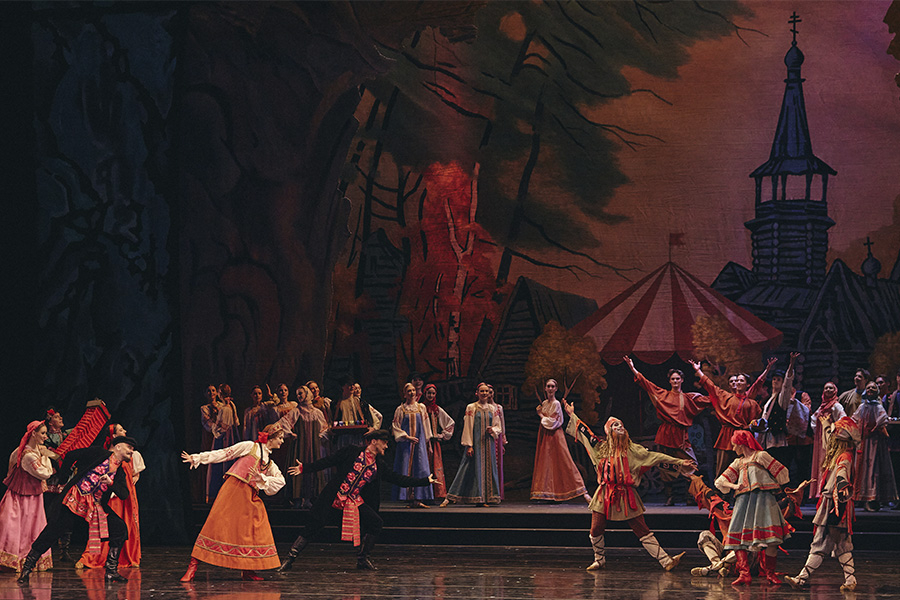
In her search she arrives at a fair and again encounters Severyan and his companions among the gypsies. He tries to take her with him, but the crowd defends her. Katerina escapes.
A mysterious woman appears before Severyan and fixes him with her gaze. Unable to move, he struggles free and runs after her as she lures him farther and farther away. Only upon reaching Snake Hill does he realise that she is the Mistress of the Copper Mountain. He begs for mercy, but she remains unyielding – and he sinks into the earth.

Act III
In a remote forest the Dancing Fire Maid (Ognevushka-Poskakushka) appears before Katerina and leads her to Snake Hill.
Danila has fulfilled his dream: he has created a perfect bowl, mastered the power of stone, and grasped the secret of his craft. He now wishes to return to the world and share this beauty with people.
But the Mistress cannot let him go – she loves him. To keep him, she enchants him, and Danila becomes motionless, like stone.
Katerina reaches the Mistress’ domain and begs for Danila to be returned. Her love, fidelity and courage move the Mistress. Though it pains her to part with him, she releases the master.
Katerina and Danila return to the world of people.

For the creators of this ballet, staged in 1957, The Stone Flower has remained in the mind as a beam of light, the light of first serious artistic triumphs. For Yuri Grigorovich it was his first major theatre production, and on a Russian theme, too, set to music by his much-admired Prokofiev. It was in this opus that the creative duo with Simon Virsaladze was established, a tandem that would unsure the success of both for many years to come. For the first performers, very young and then known only in ballet circles – Irina Kolpakova, Alla Osipenko, Alexander Gribov and Anatoly Gridin – The Stone Flower made their names famous. They became the creators of roles for the first time rather than mere interpreters of long-existing choreographic texts, they created images. And in the context of the history of Russian ballet The Stone Flower was a ray of light – a step forwards from the undanceable nature of the genre of the drama ballet.
This general engagement with a search for the new became a component part of the legend. And The Stone Flower very soon made his success a legend. Two years after the premiere at the Kirov Theatre, in 1959, the ballet was taken to the Moscow Bolshoi Theatre. In Leningrad, if one believes the bare figures of theatre statistics, over thirty years The Stone Flower was one of the most attended productions. Up until the early 1990s the legend inspired ever more new performers. Then, for over twenty years, it disappeared from the stage, returning to the St Petersburg in 2016. It came back transformed – in two acts, with revised musical scores and choreographic text for some scenes – in the 2004 version staged by Yuri Grigorovich at the Krasnodar Ballet Theatre. Having experienced this later version of the legendary production, in 2026 the Mariinsky Theatre returned to the original version, created on its stage in 1957. Olga Makarova

Any use or copying of site materials, design elements or layout is forbidden without the permission of the rightholder.
user_nameExit

The highlighting of performances by age represents recommendations.

This highlighting is being used in accordance with Federal Law N436-FZ dated 29 December 2010 (edition dated 1 May 2019) "On the protection of children from information that may be harmful to their health"