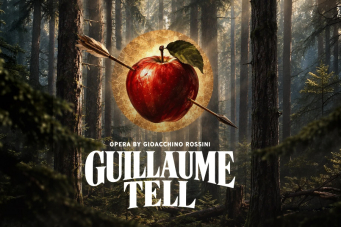



Rossini’s Guillaume Tell will receive its first performances at Mariinsky II on 16 October at 19:00 and 17 October at 12:00 and 19:00, marking the theatre’s first premiere of the season. For the first time in Russia the opera will be staged in its original language. The ambitious new production brings together the renowned Italian stage director Giancarlo del Monaco, set designer Antonio Romero and costume designer Gabriela Salaverri, with Valery Gergiev as the music director.
Guillaume Tell was Rossini’s thirty-eighth and final opera. He completed it at the age of just thirty-seven and, although he lived for almost another forty years, never wrote another opera. The work represents both the culmination of his experience as a composer and a bold step towards Romantic opera, laying the groundwork for later masterpieces by Wagner, Verdi and Berlioz.
Based on Friedrich Schiller’s play celebrating the exploits of Switzerland’s national hero, Guillaume Tell is a sweeping epic with a large cast, and Rossini’s longest and most ambitious opera. Its scale presents formidable challenges, calling for exceptional performing, artistic and technical resources. The Mariinsky Theatre is once again taking on a major work seldom staged today, giving audiences a rare opportunity to experience a masterpiece from an earlier age.
The opera received its world premiere in Paris on 3 August 1829, to a triumphant reception. It was the crowning achievement of Rossini’s operatic career. When Guillaume Tell reached Russia, however, it did so under an assumed name. Censorship had prompted extensive revisions to the libretto, altering the characters, historical period and setting. The opera was first performed in Russia on 21 April 1838 at the Bolshoi (Stone) Theatre, the Mariinsky’s predecessor, under the title Charles the Bold, in a translation by Rafail Zotov. On 22 February 1861, just four months after the opening of the new Mariinsky Theatre, Charles the Bold was presented on the stage now known as the Historic Stage.
Russian audiences had to wait until the following century to hear Rossini’s original version, once again at the Mariinsky. On 23 January 1932 the Leningrad State Academic Theatre of Opera and Ballet gave the first complete performance of the original score in Russia. In keeping with the practice of the time, the opera was sung in Russian. The production enjoyed considerable success but soon disappeared from the repertoire for decades. Although Guillaume Tell remains a rarity on the operatic stage, its celebrated overture is familiar to audiences everywhere and remains a favourite of symphony concert programmes.
The Mariinsky Theatre has approached this first fully staged production in the original language through a series of concert performances with orchestral and piano accompaniment. The new staging is in the hands of Giancarlo del Monaco, whose previous Mariinsky production, Aida, won acclaim from St Petersburg audiences and earned a Golden Mask award. He is reunited with the same design team – Antonio Romero and Gabriela Salaverri.
The result promises to be a richly detailed, visually spectacular production. Forests, mountains and lakes will evoke the dramatic Alpine landscapes of medieval Switzerland on the stage of Mariinsky II. Del Monaco’s staging draws on classical theatrical traditions, incorporating contemporary elements with a light touch.
Ahead of the premiere, the Shchedrin Hall will host a lecture on 12 October at 19:30 entitled “Grand opera, chef’s special: recipes for French and Italian opera from the composer of Guillaume Tell”. Part of the Lecture Before the Performance series, the event will feature musicologist Khristina Batyushina exploring the opera’s historical and cultural background, tracing its characters’ Alpine journeys and guiding audiences through the highlights of its rich dramatic and musical landscape.
The following singers are preparing roles in the production:
Guillaume Tell: Maharram Huseynov, Maxim Daminov, Vadim Kravets, Gleb Peryazev, Yaroslav Petryanik;
Arnold: Alexander Mikhailov, Yaramir Nizamutdinov, Anton Rositsky;
Melchtal: Mikhail Kolelishvili, Miroslav Molchanov, Yakov Strizhak, Oleg Sychov, Vladimir Feliauer;
Mathilde: Angelina Akhmedova, Maria Bayankina, Gelena Gaskarova, Yekaterina Goncharova, Irina Churilova;
Hedwige: Anna Kiknadze, Yekaterina Krapivina, Daria Rositskaya;
Jemmy: Isabella Andriasian, Kristina Gontsa, Kira Loginova, Marina Tekhteleva;
Gesler: Ilya Bannik, Gevorg Grigoryan, Yevgeny Nikitin, Andrei Serov, Oleg Sychov;
Leuthold: Denis Begansky, Alexander Gerasimov, Nikolai Kamensky, Vladimir Feliauer, Pavel Shmulevich;
Furst: Yuri Vlasov, Dmitry Grigoriev, Stepan Zavalishin, Yevgeny Chernyadiev;
Ruodi: Denis Zakirov, Stanislav Leontiev, Boris Stepanov, Klim Tikhonov.





| user_name | | Exit |